Well Drilling in Renfrew County: What You Need to Know
Renfrew County covers more than 7,400 square kilometres of eastern Ontario, stretching from the Ottawa Valley floor up into the rugged Canadian Shield highlands. The county's geology — ancient Precambrian granite, gneiss, and quartzite — shapes everything about how residential wells are drilled, how deep they need to go, and what the water quality will look like.
Unlike southern Ontario where shallow overburden wells are sometimes viable, the majority of Renfrew County residents depend on drilled wells that penetrate through soil and weathered rock into the bedrock fractures below. These fractures, opened by millennia of freeze-thaw cycling and tectonic stress, carry the groundwater that feeds most rural properties in communities from Pembroke to Eganville, from Arnprior to Deep River.
This guide exists to help property owners understand what goes into a new well installation, what it should cost, what Ontario law requires, and how to evaluate the people doing the work. It is an information resource only — there are no contractor services, forms, phone numbers, or quotes available here.
Why Drilled Wells Dominate Renfrew County
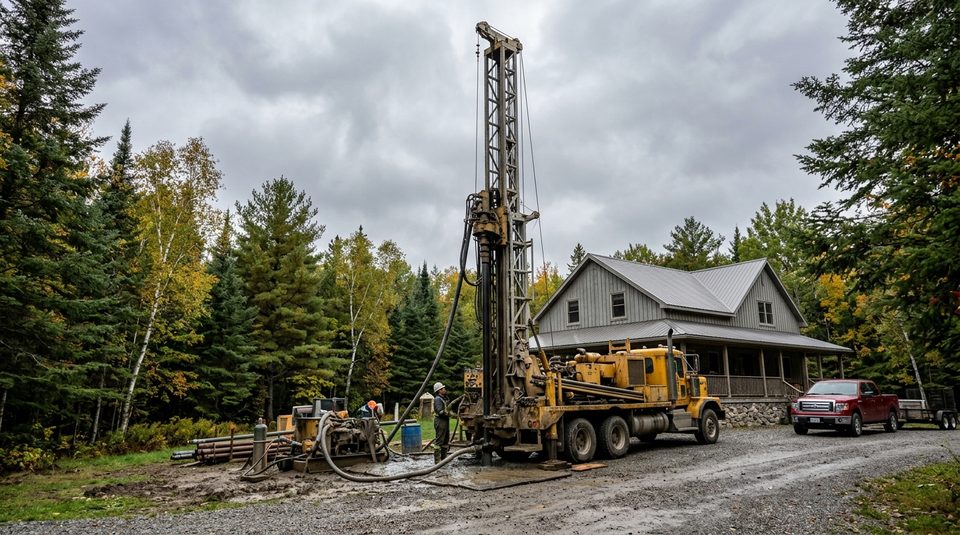
Renfrew County's Canadian Shield geology means that water-bearing rock fractures often don't occur until 50–200+ feet below surface. This rules out the shallow dug wells common in sedimentary regions. Drilled wells — typically 4- to 6-inch diameter steel or PVC casing driven through overburden and into bedrock — are the standard solution for rural properties throughout the county.
The bedrock aquifer systems in Renfrew County are highly variable. Two neighbouring properties may have dramatically different well depths and yields. One well drilled to 120 feet may produce 5 gallons per minute; a neighbouring well must go 300 feet to find adequate yield. Local hydrogeological data — available through the Ontario Ministry of Natural Resources and Forestry — can provide some guidance, but site-specific conditions always vary.
Surface Water Versus Groundwater in Renfrew County
The Ottawa River, Madawaska River, Bonnechere River, and dozens of lakes make surface water abundant across Renfrew County. However, surface water is not a practical drinking water source for most residential properties. Treating lake or river water to potable standards requires continuous filtration, UV treatment, and disinfection systems — expensive to install and demanding to maintain year-round. Groundwater from a properly constructed well provides a far more reliable and cost-effective supply for most rural homeowners.
Well Drilling Cost Overview — Renfrew County
Costs for well drilling in Renfrew County vary significantly based on depth, rock hardness, access conditions, and pump system requirements. The table below provides typical ranges for the major cost components of a new residential well installation.
| Cost Component | Typical Range (CAD) | Notes |
|---|---|---|
| Well drilling (per foot) | $30 – $55/ft | Increases with depth; hard granite Shield rock is slower to penetrate |
| Well casing (6-inch steel) | $1,200 – $3,000 | Depends on overburden depth and casing length required |
| Submersible pump system | $1,800 – $4,500 | Higher horsepower pumps needed for deeper wells |
| Pressure tank + controls | $600 – $1,800 | Larger tanks reduce pump cycling frequency |
| Wellhead cap & sanitary seal | $200 – $500 | Required under Ontario Regulation 903 |
| Well record filing | Included by licensed driller | Mandatory — contractor files the PWS Well Record form |
| Water line to house | $1,500 – $5,000 | Depends on distance from wellhead to building and frost depth |
| Full installation (typical 150 ft) | $8,000 – $16,000 | Combined estimate for average Renfrew County residential well |
Remote properties — particularly in the northern parts of Renfrew County near Chalk River, Rolphton, and the Deep River area — can see higher costs due to equipment mobilization. Rock conditions in the Madawaska Highlands around Barry's Bay and Combermere also tend to run harder, which slows drilling and increases per-foot costs.
For a full breakdown of all cost factors, see the Complete Cost Guide.
Information Guides
Drilling & Installation
How rotary percussion drilling works in Renfrew County's bedrock, casing types, well completion, and what to expect on drill day.
Read GuidePumps & Pressure Tanks
Submersible versus jet pumps, pressure tank sizing, common failure signs, and what drives pump replacement costs in Ontario.
Read GuideWater Testing & Treatment
Ontario-recommended testing schedule, what to look for in Renfrew County wells, and how common treatment systems work.
Read GuideHiring a Licensed Driller
How to verify a contractor's Ontario licence, what to ask before signing, and what a proper well completion report should include.
Read GuideRenfrew County Communities This Guide Covers
This information resource is focused on residential well drilling across Renfrew County, Ontario. The geological and regulatory considerations described here apply to properties in the following communities and surrounding rural areas:
Renfrew County's mix of Shield geology and Ottawa Valley lowland means conditions can vary significantly between different parts of the county. Properties near Arnprior and Renfrew Town sit closer to the transition zone between the Canadian Shield and the St. Lawrence Lowlands, sometimes encountering different overburden depths and water chemistry than properties further north.
Ontario Well Drilling Regulations at a Glance
All residential well drilling in Ontario — including every community in Renfrew County — is governed by the Ontario Water Resources Act and its key instrument, Ontario Regulation 903 (Wells). Key requirements that property owners should understand:
Licensing Requirements
- Only a licensed water well contractor may drill a well in Ontario
- Licences are issued by the Ministry of Environment, Conservation and Parks
- The licence number must appear on the Well Record
- Pump installation also requires a licensed well technician in Ontario
Mandatory Well Record
- The contractor must file a Well Record with the province within 30 days of completion
- Records are searchable through the Ontario Well Record Archive
- Records show depth, yield, casing specifications, and water quality at time of drilling
- Request your copy directly from MECP
For a complete overview of setback rules, permit requirements, and the Well Record process, see the Ontario Well Regulations Guide.
Renfrew County Geology and What It Means for Your Well
The Canadian Shield — one of the world's oldest geological formations — underlies virtually all of northern and central Renfrew County. This ancient Precambrian rock is dense, hard, and largely impermeable except where fractured. Those fractures are the key: groundwater in Shield country doesn't flow through porous sand and gravel the way it does in sedimentary basins. Instead, it moves through a network of rock cracks, faults, and joints.
This has practical consequences. A well driller in Renfrew County can't rely on consistent aquifer layers the way a driller in PEI or southern Ontario might. Each well is essentially an individual exploration — drilling until adequate fractures are encountered. This is why well yields in Renfrew County range from under 1 gallon per minute (marginal) to 20+ gallons per minute (excellent), sometimes within the same neighbourhood.
The Ottawa Valley portion of the county — communities like Renfrew Town, Cobden, Beachburg, and Arnprior — sometimes encounter thicker overburden (glacial till and clay) before reaching bedrock. This overburden casing costs more but the bedrock may be shallower. Northern areas near Petawawa, Chalk River, and Deep River often have thin overburden but very hard, slow-to-drill granite.
📍 Typical Well Depths by Area
- Pembroke / Petawawa: 80–180 feet to productive fractures
- Renfrew / Arnprior / Cobden: 60–150 feet; variable overburden
- Eganville / Killaloe: 100–220 feet; mixed Shield terrain
- Barry's Bay / Madawaska Highlands: 120–300+ feet; hard granite
- Deep River / Chalk River: 80–200 feet; thin overburden over hard rock
These are typical ranges based on regional data. Actual well depth depends on site-specific conditions.
Frequently Asked Questions
How deep are wells typically drilled in Renfrew County?
Most residential wells in Renfrew County reach bedrock within 20–60 feet below surface, but productive water-bearing fractures often require drilling to 100–300+ feet. The average across the county sits around 150–200 feet, though northern Shield areas around Barry's Bay and Combermere regularly see wells exceed 250 feet.
A licensed driller will typically continue until a minimum yield of 0.5 gallons per minute is sustained — though most Ontario lenders and health authorities prefer 1+ GPM for a household supply.
How much does a new drilled well cost in Renfrew County?
Total well installation costs in Renfrew County typically range from $8,000 to $20,000, covering drilling, casing, pump, pressure tank, electrical hookup, and water line to the house. Drilling alone runs approximately $30–$55 per foot.
Remote or difficult-access properties can push costs higher. A 300-foot well in hard Shield granite with a long water line will cost considerably more than a 120-foot well close to an existing structure.
Do I need a permit to drill a well in Ontario?
Yes — in two ways. First, only a contractor licensed under Ontario Regulation 903 (Wells) may legally drill a well. Second, your municipality may require a building permit or water-taking permit depending on local bylaws. The Township of Laurentian Valley, McNab/Braeside, and other Renfrew County municipalities may have additional local requirements.
The licensed contractor is responsible for filing the provincial Well Record within 30 days of completion. As the property owner, you should request a copy for your records.
How long does a drilled well last in Renfrew County?
A properly installed drilled well in Renfrew County's bedrock can last 30–50 years or longer with minimal structural issues. The well casing and cap may need inspection or replacement before the well itself fails. Submersible pumps typically last 10–15 years; pressure tanks 10–12 years with proper maintenance. Annual pump inspection and periodic water testing extend system life considerably.
What water quality concerns are common in Renfrew County wells?
Common issues include:
- Iron and manganese: Reddish staining, metallic taste. Very common in Shield wells.
- Hardness: High calcium and magnesium from limestone and granite dissolution.
- Arsenic: Naturally occurring from rock; some Renfrew County wells exceed the Health Canada guideline of 10 µg/L.
- Coliform bacteria: Can enter after heavy rain via surface infiltration. Annual testing is recommended.
- Radon: Elevated in some Shield-area wells. Worth testing if health is a concern.
Annual bacteriological testing and chemical testing every 3–5 years is the recommended baseline for Renfrew County well owners.
What are the well setback distances required in Ontario?
Ontario Regulation 903 sets minimum horizontal setback distances for new wells:
- 15 metres from a sewage system (leaching bed / tile field)
- 30 metres from a sewage tank or holding tank
- 15 metres from a property line (unless waived by adjacent owner)
- 30 metres from a fuel storage tank
- 100 metres from a livestock facility (varies by type)
Your municipality may impose additional setback requirements. Always confirm with the township before siting a new well.
See the full Well Drilling FAQ for 11+ questions answered in detail.
Maintaining Your Well in Renfrew County's Climate
Renfrew County winters are demanding. Temperatures regularly drop to −25°C or colder, and the freeze-thaw cycles of spring put mechanical strain on all above-ground components. Well maintenance in Renfrew County must account for the local climate in ways that generic guides often ignore.
The wellhead must remain frost-protected — a properly installed well cap sits high enough above grade to prevent surface water infiltration, while the buried water line runs below the frost depth (typically 4–5 feet in Renfrew County). Pressure tanks should be inspected in fall before hard freeze arrives. Spring is the highest-risk period for surface contamination, as snowmelt can drive surface water toward improperly sealed wellheads.
For seasonal maintenance checklists and guidance, see the Well Maintenance Guide.